
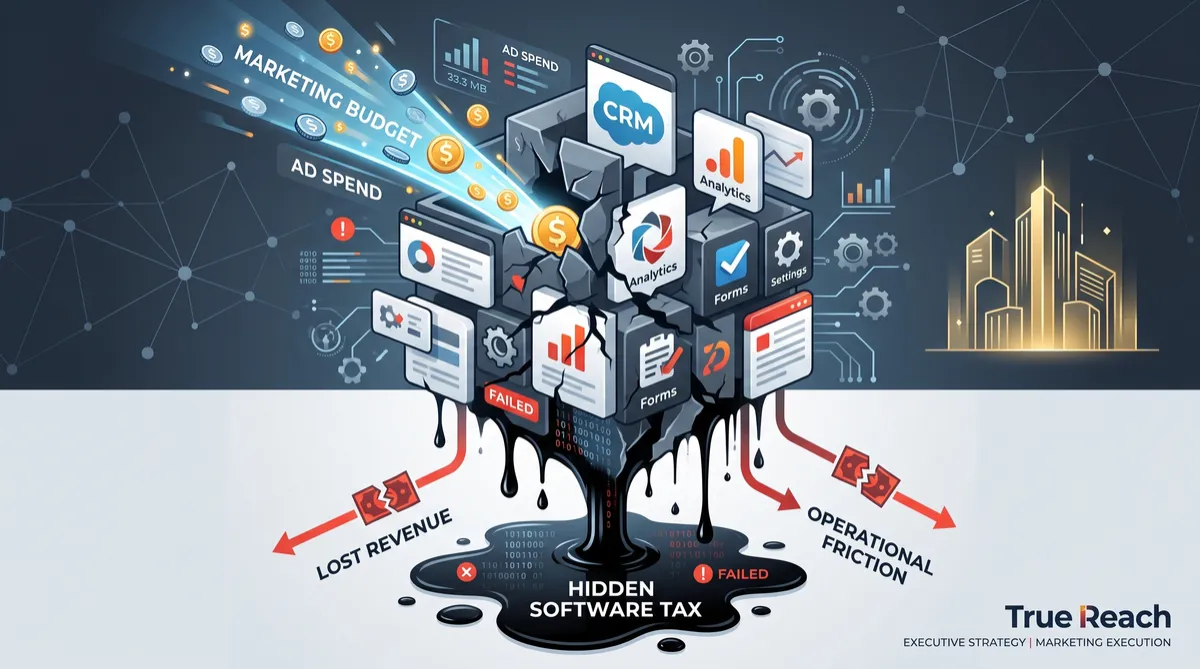
The Hidden Software Tax: How Broken Tech Stacks Drain Your Marketing Spend
The Hidden Software Tax: How Broken Tech Stacks Drain Your Marketing Spend
You just raised your ad spend by $5,000 a month. Traffic is up, click-through rates on your ad creative look promising, and your agency sends a monthly PDF report full of green arrows and high-fives.
Yet, your revenue remains completely flat.
When acquisition campaigns fail to deliver bottom-line results, the default executive response is usually to blame the top of the funnel. Teams tweak the ad copy, test new visual assets, swap out targeting parameters, or fire the ad manager. But in most growth-stage organizations, the marketing isn't broken.
Your operations are.
Behind the scenes of modern acquisition campaigns lies an invisible leak: the operational tech stack. When your backend software setup is fragmented, slow, or poorly integrated, it imposes an unseen operational tax on every single marketing dollar you deploy. You aren't losing prospective clients because your offer is weak—you are losing them because your tech stack creates friction before your sales team ever gets a chance to speak to them.
Here is how broken tech architecture silently drains your marketing margin, and how senior operators fix it to unlock scalable growth.
The Anatomy of Operational Leakage
Every lead pipeline is a chain. A break at any single link degrades the efficiency of the entire system. When scaling up marketing traffic, operational friction typically surfaces in three distinct areas:
1. Form Drop-off and Software Redundancy
Most growth companies stack software over time without a master architecture. You add a scheduling app here, an email integration there, a third-party form handler, and a consent banner. Each additional tool adds script bloat, increases page load times, and introduces extra steps for the user.
If your booking flow takes five seconds to render or requires a prospect to navigate through three separate redirects, your conversion rate drops off a cliff. You pay full price for the ad click, but your software taxes the lead before they complete the action.
2. Broken Attribution and Data Blindness
When your customer relationship management (CRM) platform, ad accounts, and conversion endpoints don't talk to each other cleanly, attribution breaks. Your team ends up optimizing campaigns for vanity conversions—like page views or initial form submits—rather than actual booked calls or closed revenue. Spending money on optimization algorithms that feed on incomplete data guarantees wasted spend.
3. Manual Workarounds and Slow Response Times
If a submitted lead requires manual review, re-keying into a secondary system, or waiting on an employee to manually send a calendar invitation, your time-to-first-contact stretches from seconds to hours. In modern customer acquisition, lead decay happens rapidly. A prospect who reaches out to three competitors will consistently sign with the firm that routes the inquiry and confirms the next step instantly.
Calculating Your Real Cost Per Acquisition
To understand the impact of tech stack friction on your margins, consider a simple pipeline audit.
Imagine two companies running identical campaigns with a $10,000/month ad budget at $10 per click (1,000 site visits):
Company A (Bloated Tech Stack): Slow page load speeds and a multi-step form yield a 3% conversion rate (30 leads). Weak CRM automation leads to manual routing delays, causing a 30% drop-off before scheduling.
Result: 21 qualified sales calls. Cost Per Call: $476.
Company B (Streamlined Architecture): Sub-second page loads, single-step direct routing, and instant calendar sync yield a 6% conversion rate (60 leads) with zero operational drop-off.
Result: 60 qualified sales calls. Cost Per Call: $166.
Company A didn't need better ad creative. They didn't need to double their ad spend. They simply needed to stop letting their backend operations tax their frontend acquisition.
The 3-Step Operations Fix
Fixing a leaking pipeline requires stripping away unnecessary software and building clean, high-leverage infrastructure.
[ Unused Tools / Slow Scripts ] ---> ELIMINATE
[ Broken Forms & Manual Steps ] ---> DIRECT ROUTE
[ Lead-to-CRM Flow ] ---> AUTOMATE & SPEED UP
Step 1: Conduct a Tech Stack Diagnostic
Audit every tool in your tech stack. Identify software redundancies, double-billing, and unused plugins running hidden background scripts on your website. If a software subscription doesn't directly contribute to lead capture, client delivery, or core tracking, eliminate it.
Step 2: Implement Direct Lead Routing
Remove intermediate manual steps between the initial inquiry and the calendar. Forms should route directly into your CRM, fire immediate confirmation protocols, and prompt qualified prospects to book directly on the thank-you page.
Step 3: Align Metrics Around Revenue, Not Clicks
Configure clean server-side tracking so your ad platforms receive feedback based on actual revenue events rather than top-of-funnel clicks. When your ad algorithms optimize for actual pipeline value, your cost-per-lead drops naturally.
Stop Paying the Friction Tax
Scaling a business requires capital efficiency. Before you increase your ad budget or sign another monthly retainer with a marketing agency promising quick fixes, look closely at your operational foundation.
Eliminate software bloat, fix your booking pipelines, and ensure your tech stack works for your growth strategy rather than against it. When you eliminate operational friction, your existing marketing instantly becomes twice as effective.


